Preparing Tops for Longarming
Getting Your Quilt Tops Ready for Machine Quilting by a Professional Longarm Quilter
By Susan Slattery, Reprinted from Threadworks Quilting
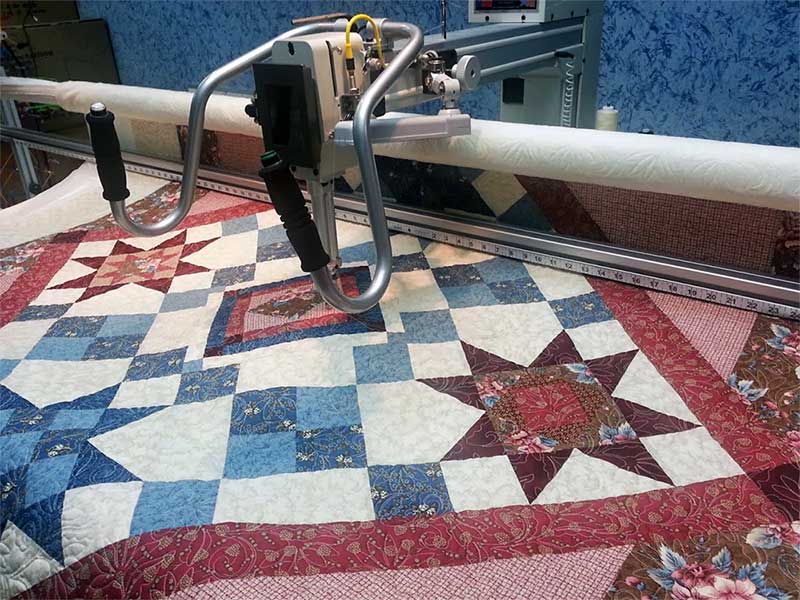
Not all professional longarm quilters have the same preparation requirements or preferences. The following is a list of guidelines that I provide to my clients. Check with your longarmer to see how they would like for you to prepare the quilt, which may differ from what you see here:
To prewash or not to prewash? Whether to prewash your quilt top and backing or not is a preference – there is no right or wrong answer. You should, however, be consistent and wash all or nothing, including the batting. Because unquilted batting is difficult to wash without damaging it, I generally prefer not to prewash. Here is a helpful article with points to consider: http://www.connectingthreads.com/tutorials/To_Prewash_or_Not_to_Prewash__D85.html
The quilt top Remove all loose threads. Inspect carefully for open seams that may have come loose during handling, and repair them if necessary. If I don’t notice them, the computerized quilting system could catch them and damage the quilt. (Note: Not all longarm quilters use computerized system as I do. Many hand guide the quilting patterns. Open seams on the top should be repaired nonetheless.)
Borders As quilters, we have all faced challenges with borders at one time or another. As you check your quilt top to insure it is ready to quilting, lay it on a flat surface, such as the floor or a bed or a large table. Do your borders lay flat or are they wavy? If they are only slightly wavy, I do have a few tricks up my sleeve and I may be able to work with them. Depending on the circumstances, this may or may not require an additional fee. If the borders are excessively wavy, you should remove, resize and reattach them prior to quilting.
Pressing You will want to insure that both your quilt top and your back are carefully pressed and all seams are flat. Using starch or sizing is really helpful (but not required), as it makes it easier to work with and quilt. Fold neatly. I may give your quilt top and back a light press once more before loading onto the frame if needed, but it needs to be pretty well pressed already.
Backing Remove all loose threads. Your backing should be a minimum of 4″ wider than the quilt top on all sides (but need not exceed 6″). In other words, if your quilt top is 90″ x 100″, your backing should be at least 98″ x 108″. Please take the time to square the backing. This is very important for insuring your quilt loads square on the frame. If you will need to piece the backing, you should cut off the selvedge edges on the edges that will be sewn together to make a seam. Selvedge edges are usually a little thicker and bulker than the rest of the fabric, and a this bulkiness will be noticeable in the finished quilt. Also, they shrink at a different rate when the quilt is washed, creating a puckered line. Also, make the seams 1/2″ (rather than than the 1/4″ seams on the top) and press the seam open.
Batting If you are providing your own batting, make sure the piece you plan to use is at least 3″ wider (but no more than 6″ wider) than the quilt top on all sides. That means if your quilt top is 90″ x 100″, your batting should be at least 96″ x 106″.
The quilt sandwich Don’t baste or pin the quilt layers together. Basting will be done on the longarm frame. If your quilt top or backing are directional, mark the top center with a large and obvious note attached by safety pin. Make sure you remember to mention it also.
Here is another list by professional longarm quilter and guild member, Johanna Roll.
Checklist for Getting Tops Ready for Longarming
By Johanna Roll
- This begins with block construction. Press all blocks as they are constructed. Make sure seams do not have a little folded back part. Press open if necessary.
- Make sure quilt is square and lays flat. There should be no peak in the center of the blocks or quilt. Trim off excess.
- Be sure all seams are sewn and clip threads. Trim off dog ears.
- If edges are on bias, stay-stitch around quilt with shortened stitch 1/8” from edge.
- If embellishments are used, be sure you know how your quilter feels about them.
- Keep all three layers separate, do not pin or baste together.
- Make sure the backing and batting are at least 4-5” larger than quilt on each side.
- Backing needs to be square or rectangular. Opposite edges need to be the same length.
- Don’t use a sheet for backing. The thread count is too high and the needle may break threads.
- Press completed top
One method to put on borders without waves:
By Johanna Roll
- After all blocks are put together, press entire top flat and measure and write down top width, middle, and bottom. Calculate the average of this number and cut 2 border strips this length.
- If fabric allows, use lengthwise of material since there is less stretch in this direction. If WOF is used, be careful not to stretch the fabric.
- Pin these strips on 2 sides of the top. Pin each end of strip to ends of quilt. Fold both together in half and pin centers together. Follow this method until pins are 10” to 12” apart. Sew on.
- Iron seams and measure the sides that need borders in the same way as above. Cut 2 more strips and pin, pin, pin. Sew on.
- Iron seams.
- Call your longarmer and make an appointment to give them your quilt.
- Enjoy your beautiful new quilt!